In this and the following chapters, we will present a very important topic: AC, or Alternating Current. The name alternating current is not very precise and normally covers circuits with sinusoidal voltages and currents; however, alternating current can also mean any arbitrary current waveform. The importance of AC voltage is that this kind of voltage is used for the main electric power source in homes and industry throughout the world. It is also the basis for many electronics, telecommunication, and industrial applications.
To handle sinusoidal waveforms and the circuits associated with them, we will use a simple and elegant method called the method of phasors. Phasors are based on the properties of complex numbers, which are ideal for representing sinusoidal quantities. In this chapter, we will summarize the principal facts about complex numbers and their operations. We will also show how makes it easy to do calculations with complex numbers.
Complex numbers consist of two parts, a real part(x), which is a real number, and a so called imaginary part (y), which is a real number multiplied by  ,the imaginary unit. The complex number z, therefore, can be described as:
,the imaginary unit. The complex number z, therefore, can be described as:
z = x + jy
where  .
.
.
Examples of complex numbers:
z 1 = 1+ j
z 2 = 4-2 j
z 3 =3- 5j
Complex numbers were originally introduced in the seventeenth century to represent the roots of polynomials which could not be represented with real numbers alone. For example, the roots of the equation x2 +2x +2 = 0 can only be described as  and
and  , or using the notation
  , z1= 1+ j and z2= 1- j. Using the new notation to investigate the properties of expressions, mathematicians were able to prove theorems and solve problems which until then had been difficult if not impossible to solve. This led to the elaboration of complex algebra and complex functions, which now are widely used in mathematics and engineering.
and , or using the notation , z1= 1+ j and z2= 1- j. Using the new notation to investigate the properties of expressions, mathematicians were able to prove theorems and solve problems which until then had been difficult if not impossible to solve. This led to the elaboration of complex algebra and complex functions, which now are widely used in mathematics and engineering.
Geometric representation of complex numbers
Rectangular form
Because a complex number can always be separated into its real and complex parts, we can represent a complex number as a point on a two-dimensional plane. The real part of a complex number is the projection of the point onto the real axis, and the imaginary part of the number is the projection onto the imaginary axis. When a complex number is represented as the sum of real and imaginary parts, we say it is in rectangular or algebraic form.
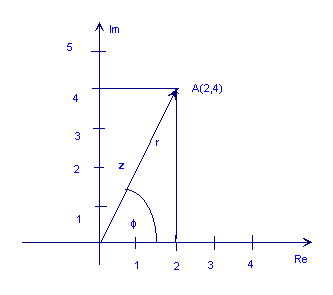
The following figure shows the complex number z = 2 + 4j
As you can see from the figure above, the point A could also be represented by the length of the arrow, r (also called the absolute value, magnitude, or amplitude), and its angle (or phase), φ relative in a counterclockwise direction to the positive horizontal axis. This is the polar form of a complex number. It is denoted as r ∠ φ.
The next step is very important. A complex number in polar form can also be written in exponential form:

This simple expression is distinctive in that it has an imaginary number in the exponent instead of the usual real number. This complex exponential behaves very differently from the exponential function with a real argument. While ex grows rapidly in magnitude for increasing x>0 and decreases for x<0, the function  has the same magnitude (z =1) for any φ. Furthermore, its complex values lie on the unit circle.
has the same magnitude (z =1) for any φ. Furthermore, its complex values lie on the unit circle.
Euler’s formula provides a unifying link among the rectangular, polar, and exponential forms of complex numbers:
z = x + jy = r e jφ = r ( cos φ + j sin φ )
where 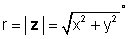
and φ = tan-1 (y/x).
For our example above, z = 2 + 4j:

φ = tan-1 ( 4/2) = 63.4°
therefore  .
.
.
Or vice-versa:

You will need to be adept at using both forms, depending on the application. For example, addition or subtraction are obviously easier to do when the numbers are in rectangular form, while multiplication and division are easier to do when the numbers are in exponential form.
Operations with complex numbers
The operations that can be done with complex numbers are similar to those for real numbers. The rules and some new definitions are summarized below.
Operations with j
The operations with j simply follow from the definition of the imaginary unit,

To be able to work fast and accurately, you should memorize these rules:
j 2 = -1
j 3 =-j
j 4 =1
1/j = -j
Proof:
j2 = -1 simply follows from the definition of , since
For 1/j, we multiply 1/jby j / j =1 and get j/ (j j) = j /(-1) = -j.
j2 = -1 simply follows from the definition of
, since For 1/j, we multiply 1/jby j / j =1 and get j/ (j j) = j /(-1) = -j.
Complex conjugate
The complex conjugate of a complex number is easily derived and is quite important. To obtain the complex conjugate of a complex number in rectangular form, simply change the sign of the imaginary part. To do so for a number in exponential form, change the sign of the angle of the complex number while keeping its absolute value the same.
The complex conjugate of a complex number z is often denoted by z*.
Given the complex number z=a+ jb, its complex conjugate is z*=a– jb.
If z is given in exponential form,  , its complex conjugate is
, its complex conjugate is
Using the definitions above, it is easy to see that a complex number multiplied by its complex conjugate gives the square of the absolute value of the complex number:
z z* = r2 = a2 + b2
Also, by adding or subtracting any complex number and its conjugate, we get the following relations:
z + z * = 2a
therefore
Re(z) = a = ( z + z * )/ 2
Similarly:
z - z * =j2b
therefore
Im(z) = b = ( z -z * )/ 2j
Proof:

or multiplying the real and imaginary parts and using j2= -1
z z* =(a+ jb)(a – jb)=a2+a jb - a jb – jbjb = a2j2= a2 + b2
z + z* =a+ jb + a – jb = 2a
z - z*=a+ jb - a + jb =j2b
In rectangular form:
z =3+ j4
z* =3– j4
z z * =9+16=25
In polar form
z = 5 ∠ 53.13°
z * =5 ∠- 53.13°
In exponential form:


Addition and subtraction
Addition and subtraction of complex numbers is straightforward—we only need to add the real and imaginary parts separately. For example, if
z1 = 3 – 4j and z2 = 2 + 3j
then
z1 + z2 = 3 – 4j + 2 + 3j = 3 + 2 – 4j + 3j = 5 - j
z1 - z2 = 3 – 4j - 2 - 3j = 3 - 2 – 4j - 3j = 1 – j7
Obviously, we should use the rectangular form for these operations. If the numbers are given in exponential or polar form, we should transform them first to rectangular form using Euler’s formula, as given earlier.
Multiplication
There are two methods for multiplication of complex numbers--
Multiplication of complex numbers given in rectangular form
To carry out the operation, simply multiply the real and imaginary parts of one number in turn by the real and imaginary parts of the other number and use the identity j2 = -1.
z1z2 = (a1 + jb1) (a2 + jb2)= a1 a2 + jb1a2+ jb2a1 – b1b2 = a1 a2– b1b2 + j(b1a2+ jb2a1)
When the complex numbers are given numerically, it is not necessary to use the formula above. For example, let
z1 = 3 – 4j and z2 = 2 + 3j
With direct multiplication of the components:
z1z2 = (3 – 4j)( 2 + 3j)=6- 8j +9j + 12 =18 + j
or using the formula: z1z2 = a1 a2– b1b2 + j(b1a2+ b2a1)
z1z2 = 6 +12 + j ( -8 + 9) = 18 + j
We think you’re more likely to make an error if you use the formula than if you multiply the components directly.
| {Solution } z1:=3-4*j z2:=2+3*j z1*z2=[18+1*j] |
Multiplication of complex numbers given in polar or exponential form
To carry out this operation, multiply the absolute values and add the angles of the two complex numbers. Let:

Then using the rule of multiplication of exponential functions:

or in polar form
z1 z2 = r1 r2 ∠ φ1 + φ2
Note: We have already used this rule when we calculated z z *above. Since the angle of the conjugate has the opposite sign of the original angle, a complex number multiplied by its own conjugate is always a real number; namely, the square of its absolute value: z z * = r2
For example, let:
z1 = 5 ∠ 30° and z2 = 4 ∠ -60°
then
z1z2 = 20 ∠ -30°
or in exponential form
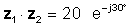
Multiplication is obviously simpler when the numbers are in polar or exponential form.
However, if the complex numbers are given in rectangular form, you should consider performing the multiplication directly as shown above, since there are additional steps if you convert the numbers to polar form before multiplying them. Another factor to consider is whether you want the answers to be in rectangular form or in polar/exponential form. For example, if the two numbers are in rectangular form but you would like their product in polar form, it makes sense to convert them immediately and then multiply them.
Division
There are two methods for division of complex numbers--
Division of complex numbers given in rectangular form
To carry out the operation, multiply the numerator and the denominator by the conjugate of the denominator. The denominator becomes a real number and the division is reduced to the multiplication of two complex numbers and a division by a real number, the square of the absolute value of the denominator.
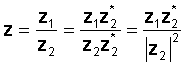
For example let:
z1 = 3 – 4j and z2 = 2 + 3j

Let’s check this result with
| {Solution } z1:=3-4*j z2:=2+3*j z1/z2=[-461.5385m-1.3077*j] |
Division of complex numbers given in polar or exponential form
To carry out the operation, divide the absolute values (magnitudes) and subtract the angle of the denominator from the angle of the numerator. Let:

then using the rule of division of exponential functions

or in polar form
z 1 / z2 = r1 / r2 ∠ φ 1- φ 2
For example, let:
z 1 = 5 ∠ 30° and z 2 = 2 ∠ -60°
then
z 1 / z2 = 2.5 ∠ 90°
or in exponential and rectangular forms

Let’s check this result with
| {Solution} z1:=5*exp(j*degtorad(30)) z2:=2*exp(j*degtorad(-60)) z1/z2=[0+2.5*j] |
Division is obviously simpler when the numbers are in polar or exponential form.
However, if the complex numbers are given in rectangular form, you should consider performing the division directly using the complex conjugate method as shown above, since there are additional steps if you convert the numbers to polar form before dividing them. Another factor to consider is whether you want the answers to be in rectangular form or in polar/exponential form. For example, if the two numbers are in rectangular form, but you would like their quotient in polar form, it makes sense to convert them immediately and then divide them.
Now let us illustrate the use of complex numbers by more numerical problems. As usual, we will check our solutions using the works with radians, but it has standard functions for the conversion of radians to degrees or vice-versa.
Example 1 Find the polar representation:
z = 12 – j 48
 or 49.48 ∠ - 75.96°
| {Solution } z:=12-j*48; abs(z)=[49.4773] arc(z)=[-1.3258] radtodeg(arc(z))=[-75.9638] |
Example 2 Find the rectangular representation:
z = 25 e j 125 °

| {Solution } z:=25*exp(j*(degtorad(125))); z=[-14.3394+20.4788*j] Re(z)=[-14.3394] Im(z)=[20.4788] |
Example 3 Find the polar representation of the following complex numbers:
z 1 = 12 + j 48 z2 = 12 - j48 z3= -12 + j 48 z4= -12 – j 48
The absolute values of all four numbers are the same because the absolute value is independent of the signs. Only the angles are different.
{Solution }
z1:=12+j*48; abs(z1)=[49.4773] arc(z1)=[1.3258] radtodeg(arc(z1))=[75.9638] z2:=12-j*48; abs(z2)=[49.4773] arc(z2)=[-1.3258] radtodeg(arc(z2))=[-75.9638]
z3:=-12+j*48;
abs(z3)=[49.4773] arc(z3)=[1.8158] radtodeg(arc(z3))=[104.0362]
z4:=-12-j*48:
abs(z4)=[49.4773] arc(z4)=[-1.8158] radtodeg(arc(z4))=[-104.0362] |
arc() function determines the angle of any complex number, automatically placing it correctly in one of the four quadrants.
Be careful, however, using the tan-1 function to find the angle, since it is restricted to returning angles only in the first and fourth quadrants (–90°<φ<90°).
Since z1 is located in the first quadrant of the coordinate system, the calculation is:
α 1 = tan-1(48/12)= tan-1(4)= 75.96°
Since z4 is located in the third quadrant of the coordinate system, tan-1does not returns the angle correctly. The angle calculation is:
α 4 = 180° +75.96° = 255.96° or -360° +255.96° = - 104.04° , which is the same as calculated
z2 is located in the fourth quadrant of the coordinate system The angle calculation is:
α 2 = tan-1(-48/12)= tan-1(-4) = -75.96°
z3, however, is in the 2nd quadrant of the coordinate system, so tan-1 does not return the angle correctly. The angle calculation is:
α 3 = 180° -75.96° = 104.04°.
Example 4 We have two complex numbers: z1= 4 – j 6 and z2 = 5 ej45 ° .
Find z3 = z1 + z2; z4 = z1 - z2; z5 = z1 * z2; z6 = z1 / z2
First we solve the problem using Notice how
effortlessly handles the two complex numbers given in different forms.
The solution is more complicated without the interpreter. So that we can compare the different methods of multiplication and division, we will first determine the polar form of z1 and the rectangular form of z2 .

Next, we find the four solutions using the easiest forms first: rectangular for addition and subtraction, and exponential for multiplication and division:

z 3 = z1 + z2 = 4 – j 6 + 3.535 + j 3.535 = 7.535 – j2.465
z 4 = z1 – z2 = 4 – j 6 - 3.535 - j 3.535 = 0.465 – j9.535
z 5 = z1 * z2 = 7.21*5*ej(-56.31 ° +45° ) = 36.05 e –j11.31 ° =36.03*(cos(-11.31° )+j*sin(-11.31° ))
z 5 = 35.33 – j 7.07
z 6 = z1/z2= (7.21/5)*e j (-56.31 ° -45° ) = 1.442 e – j 101.31 ° = 1.442 (cos(-101.31° )+j*sin(-101.31° ))
z 6 = -0.2828 – j 1.414
which agree with the results obtained with the
The multiplication carried out in rectangular form:
z 5 =z1*z2 = (4-j6)*3.535*(1+j) = 7.07*(2-j3)*(1+j)=7.07*(2-j3+j2+3)=7.07*(5-j)=35.35-j7.07
Finally the division carried out in rectangular form:

SInusoid
The sine wave or sinusoid is a mathematical curve that describes a smooth repetitiveoscillation. It is named after the function sine, of which it is the graph. It occurs often in pure and applied mathematics, as well as physics, engineering, signal processing and many other fields. Its most basic form as a function of time (t) is:

where:
- A = the amplitude, the peak deviation of the function from zero.
- f = the ordinary frequency, the number of oscillations (cycles) that occur each second of time.
- ω = 2πf, the angular frequency, the rate of change of the function argument in units ofradians per second
 = the phase, specifies (in radians) where in its cycle the oscillation is at t = 0.
- When is non-zero, the entire waveform appears to be shifted in time by the amount /ω seconds. A negative value represents a delay, and a positive value represents an advance.

PHASOR
In physics and engineering, a phasor (a portmanteau of phase vector[1][2]), is a complex number representing a sinusoidal function whose amplitude (A), angular frequency (ω), and initial phase (θ) are time-invariant. It is related to a more general concept called analytic representation,[3] which decomposes a sinusoid into the product of a complex constant and a factor that encapsulates the frequency and time dependence. The complex constant, which encapsulates amplitude and phase dependence, is known as phasor, complex amplitude,[4][5]and (in older texts) sinor[6] or even complexor.[6]
A common situation in electrical networks is the existence of multiple sinusoids all with the same frequency, but different amplitudes and phases. The only difference in their analytic representations is the complex amplitude (phasor). A linear combination of such functions can be factored into the product of a linear combination of phasors (known as phasor arithmetic) and the time/frequency dependent factor that they all have in common.
The origin of the term phasor rightfully suggests that a (diagrammatic) calculus somewhat similar to that possible for vectors is possible for phasors as well.[6] An important additional feature of the phasor transform is thatdifferentiation and integration of sinusoidal signals (having constant amplitude, period and phase) corresponds to simple algebraic operations on the phasors; the phasor transform thus allows the analysis (calculation) of theAC steady state of RLC circuits by solving simple algebraic equations (albeit with complex coefficients) in the phasor domain instead of solving differential equations (with real coefficients) in the time domain.[7][8] The originator of the phasor transform was Charles Proteus Steinmetz working at General Electric in the late 19th century.[9][10]
Complex Number In AC circuit
The time derivative or integral of a phasor produces another phasor.[b] For example:

Therefore, in phasor representation, the time derivative of a sinusoid becomes just multiplication by the constant, 
Similarly, integrating a phasor corresponds to multiplication by 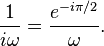 The time-dependent factor,
  , is unaffected.
The time-dependent factor, , is unaffected.
When we solve a linear differential equation with phasor arithmetic, we are merely factoring out of all terms of the equation, and reinserting it into the answer. For example, consider the following differential equation for the voltage across the capacitor in an RC circuit:
out of all terms of the equation, and reinserting it into the answer. For example, consider the following differential equation for the voltage across the capacitor in an RC circuit:
When the voltage source in this circuit is sinusoidal:

we may substitute:


where phasor  and phasor
  is the unknown quantity to be determined.
and phasor is the unknown quantity to be determined.
In the phasor shorthand notation, the differential equation reduces to[c]:

Solving for the phasor capacitor voltage gives:

As we have seen, the factor multiplying  represents differences of the amplitude and phase of
  relative to
  and
and 
represents differences of the amplitude and phase of relative to and
In polar coordinate form, it is:

Therefore:

Addition[edit]
The sum of multiple phasors produces another phasor. That is because the sum of sinusoids with the same frequency is also a sinusoid with that frequency:

![\begin{align}
A_1 \cos(\omega t + \theta_1) + A_2 \cos(\omega t + \theta_2)
&= \operatorname{Re} \{A_1 e^{i\theta_1}e^{i\omega t}\} + \operatorname{Re} \{A_2 e^{i\theta_2}e^{i\omega t}\} \\[8pt]
&= \operatorname{Re} \{A_1 e^{i\theta_1}e^{i\omega t} + A_2 e^{i\theta_2}e^{i\omega t}\} \\[8pt]
&= \operatorname{Re} \{(A_1 e^{i\theta_1} + A_2 e^{i\theta_2})e^{i\omega t}\} \\[8pt]
&= \operatorname{Re} \{(A_3 e^{i\theta_3})e^{i\omega t}\} \\[8pt]
&= A_3 \cos(\omega t + \theta_3),
\end{align}](https://upload.wikimedia.org/math/9/1/e/91ebad595facf98aa9d16513354f78ab.png)
where:


or, via the law of cosines on the complex plane (or the trigonometric identity for angle differences):

where  . A key point is that A3 and θ3 do not depend on ω or t, which is what makes phasor notation possible. The time and frequency dependence can be suppressed and re-inserted into the outcome as long as the only operations used in between are ones that produce another phasor. In angle notation, the operation shown above is written:
. A key point is that A3 and θ3 do not depend on ω or t, which is what makes phasor notation possible. The time and frequency dependence can be suppressed and re-inserted into the outcome as long as the only operations used in between are ones that produce another phasor. In angle notation, the operation shown above is written:
Another way to view addition is that two vectors with coordinates [A1 cos(ωt + θ1), A1 sin(ωt + θ1)] and [A2 cos(ωt + θ2), A2 sin(ωt + θ2)] are added vectorially to produce a resultant vector with coordinates [A3 cos(ωt + θ3), A3 sin(ωt + θ3)]. (see animation)

In physics, this sort of addition occurs when sinusoids interfere with each other, constructively or destructively. The static vector concept provides useful insight into questions like this: "What phase difference would be required between three identical sinusoids for perfect cancellation?" In this case, simply imagine taking three vectors of equal length and placing them head to tail such that the last head matches up with the first tail. Clearly, the shape which satisfies these conditions is an equilateral triangle, so the angle between each phasor to the next is 120° (2π/3 radians), or one third of a wavelength λ/3. So the phase difference between each wave must also be 120°, as is the case in three-phase power
In other words, what this shows is:

In the example of three waves, the phase difference between the first and the last wave was 240 degrees, while for two waves destructive interference happens at 180 degrees. In the limit of many waves, the phasors must form a circle for destructive interference, so that the first phasor is nearly parallel with the last. This means that for many sources, destructive interference happens when the first and last wave differ by 360 degrees, a full wavelength  . This is why in single slitdiffraction, the minima occurs when light from the far edge travels a full wavelength further than the light from the near edge.
. This is why in single slitdiffraction, the minima occurs when light from the far edge travels a full wavelength further than the light from the near edge.
No comments:
Post a Comment